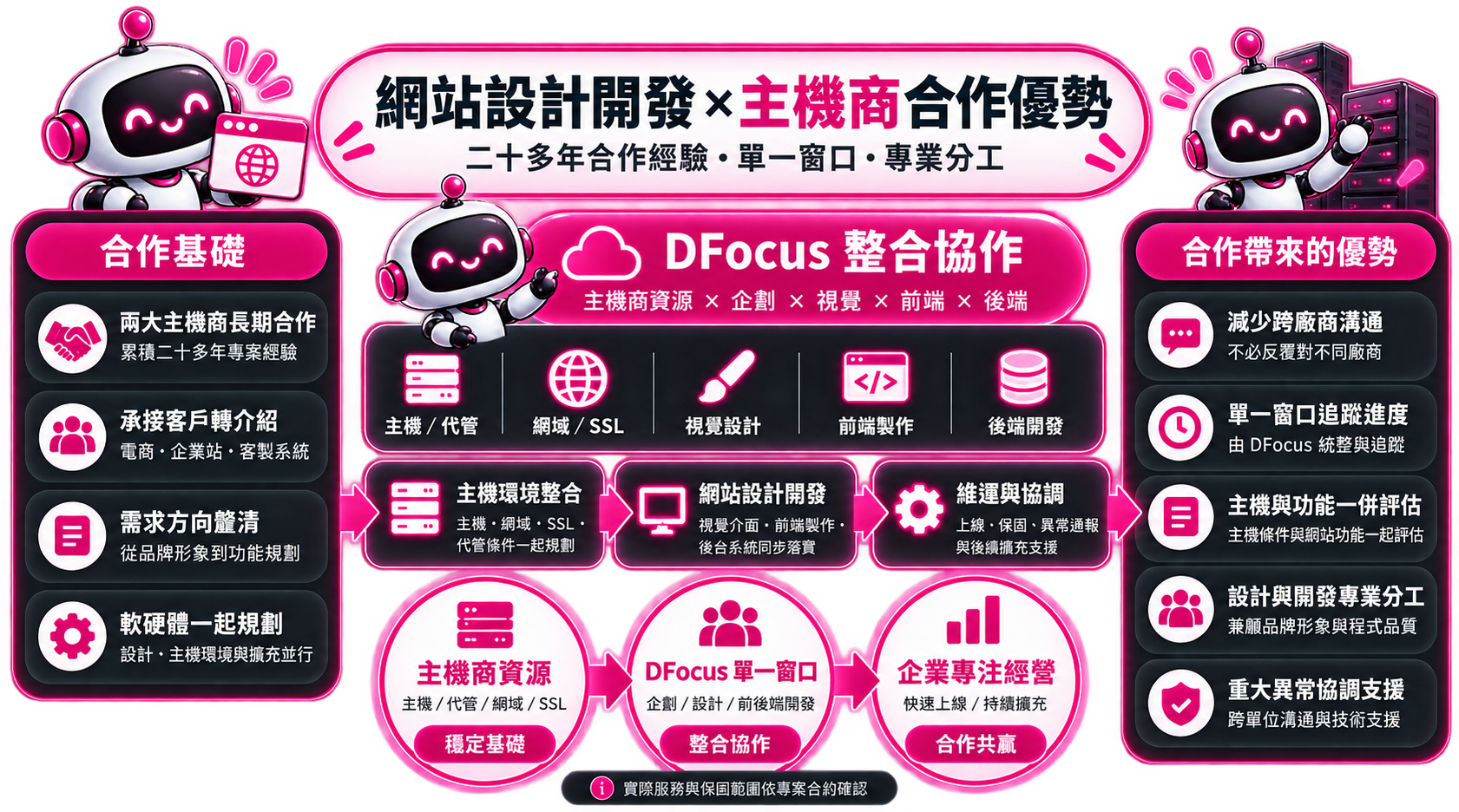
An online store built around the way you do business.
Custom E-Commerce Development
Custom shopping carts, member pricing, promotions, payments, and back-office tools—planned around your business, not a fixed template.
Start with How You Sell
This is suitable for businesses preparing to start taking orders online or looking to integrate existing products, orders, and membership operations. Clarifying your sales model and internal processes before deciding on the necessary website features will make the development scope clearer.
The following are the directions for requirements assessment. The actual projects undertaken will be confirmed based on the quote and project specifications.
Products and Catalogs
Organize categories, specifications, images, prices, and product information sources; if a price inquiry is required for a product, the catalog and inquiry process can be discussed.
Shopping and Orders
Confirm shopping cart, checkout, shipping costs, payments, shipment, and notification requirements, and review exceptional cases such as failed transactions, cancellations, and returns.
Membership and Permissions
Discuss whether membership login, tiered access, business customer approval, or different your team’s backend operation permissions are required.
Data and system integration
Take stock of existing inventory, ERP, or other data sources, and evaluate the integration method based on API, authorization, and testing conditions.
Open Source, SaaS, or Custom: What Are You Actually Buying?
They can both sell goods, but the delivery method and long-term responsibility differ.
What to Compare
Open-Source Store Setup
Hosted Platform / SaaS
DFocus Custom Development
Common examples
WordPress + WooCommerce, OpenCart
SHOPLINE, 91APP, etc.; products, modules, and contract terms vary.
Customized visuals, shopping cart, and back-end processes to meet your business needs.
Initial investment
The kit core is free; installation, templates, setup, and production are charged separately.
Annual/monthly fee; some plans also have activation setup fees and additional module purchase fees.
Requirements specifications, UI/UX, front-end, back-end, integration and testing; pricing based on scope.
Best Fit
Limited budget, standard shopping rules, and can accept existing add-on combinations.
Looking to open a store quickly, use the platform's standard features, and have the platform handle maintenance?
The operation process is unique, requiring a dedicated brand interface, role permissions, or integration with multiple systems.
Expansion Limitations
The quality of the add-on, version compatibility, and upgrade costs after significant modifications must be evaluated; open-source add-ons can also be customized, but an additional engineering estimate is required.
Depending on the platform's solution, API permissions, and customization options, not every platform is incompatible.
Planning can proceed according to specifications, but technical feasibility, timeline, and new features still need to be evaluated.
Renewal, modules, potential revenue-based billing and payment processing fees; subject to contract confirmation.
Host domain, maintenance and out-of-warranty work, third-party licensing and payment services, etc., are listed in the quote.
Delivery/Relocation
Self-hosting does not mean that all materials and plugins can be freely sublicensed; account verification and backup delivery are required.
Confirm data export fields, API, and post-cancellation access and transfer costs; do not assume that the platform program can be taken away.
The contract specifies the source code, database, deployment files, account, authorization, and scope of handover, and does not use the word "custom" to replace the delivery terms.
What Does a TWD 30,000–60,000 Template Store Include?
If the kit prices you are comparing are around TWD 30,000–60,000 , please consider this as a comparison budget for "basic installation, configuration, and setup," not the official price of the kit, a complete market survey, or DFocus's kit promises. Each vendor's included features, product availability, payment and shipping, design, taxes, and warranty differ; you cannot judge whether they are the same based solely on the total price.
The open-source kit itself and the outsourcing costs should be considered separately.
If you receive a basic setup quote of TWD 30,000–60,000, you need to confirm the theme, add-on licenses and renewals, payment and shipping settings, host and update responsibilities; special features will be estimated separately.
If you receive a basic setup quote of TWD 30,000–60,000, please confirm whether the language, version, Taiwan payment and shipping module, version compatibility, and maintenance are included; in-depth modifications will be estimated separately.
“All the Features. You Own the Website.” What a TWD 50,000 Offer May Leave Out
A one-time purchase is a transaction and licensing condition, not a technical specification, and does not guarantee lifetime maintenance. Buyout plans on the market may use open-source packages, vendor-owned systems, or hybrid modules; the underlying technology cannot be inferred from the name alone. "No monthly fee" does not mean no hosting, licensing, updates, maintenance, or migration fees.
Based on over 30 years of development experience, the head of DFocus advises businesses not to mistake "many features" for "suitability." If the vendor lacks technical maintenance capabilities and hasn't purchased clear maintenance services, acquiring a large number of features at once may actually lead to more setup, updates, and troubleshooting. This is a practical perspective on solution selection, not a conclusion drawn from vulnerability testing of a specific vendor.
1. The scope of the one-time purchase is unclear; it may only involve acquiring the right to use a specific version.
Please include the complete program, database, deployment files, management account, and modification and migration rights in the contract. Usability does not equate to rewriting, and backup capability does not guarantee maintenance by other vendors; licenses for third-party plugins, fonts, and images may not be transferable. Do not judge the completeness of the delivery solely based on the statement "the entire website is yours" before confirming the terms.
2. Even if subscription fees are saved, someone still needs to be responsible for cybersecurity updates.
One-time-purchase systems won't stop vulnerabilities from appearing; SSL cannot replace patching. If the core system, add-ons, and hosting environment are not continuously updated, or if components that are no longer maintained are still used, security risks may increase. The more modules a suite has, the more dependencies need to be inventoried and tested; however, the number of modules itself does not prove that the system has vulnerabilities.
Please clarify: Who performs the security updates, is there an additional charge, is there a test environment before the update, can the system be restored if it fails, are there off-site backup and restore drills, and how are major anomalies reported? WooCommerce also requires continuous updates, monitoring, and backups; these responsibilities do not disappear due to a one-time payment.
3. More Features Can Mean More Setup and Training
Membership, profit sharing, bonuses, discounts, and delivery exist independently, but this doesn't mean their combination will suit your workflow. Multiple sets of rules may affect each other; too many backend options, a lack of role definition or operational tutorials, will increase training and error costs. The focus should be on whether employees can complete the task, not just whether function buttons appear.
4. Updates and expansions may incur additional charges and may require re-performing compatibility tests.
Please verify that the renewal of paid modules, changes to the payment and shipping integration API, hosting environment upgrades, and version updates are included in the service. After adding new modules or making significant modifications, the original shopping, payment, discount, and shipping processes must also be tested; it should not be assumed that all future needs can be applied for free.
5. A one-time purchase without maintenance and support may be more difficult to operate than a lease.
Renting a platform comes with ongoing costs and limitations, but typically integrates existing platform maintenance; a one-time purchase, on the other hand, requires confirmation of who will actually undertake these tasks. For companies lacking technical staff and maintenance budgets, a one-time purchase plan lacking delivery, training, and update support may impose a heavier management burden than a suitable subscription platform. One-time-purchase systems with complete maintenance and handover arrangements are still worth evaluating; neither rental nor customization is risk-free.
Ask for These Five Demonstrations Before You Pay
A product update is completed when actual users add products, specifications, and images.
Run the payment success, payment failure, cancellation and refund process once, confirm the status and receive notifications.
Use different user accounts to ensure that there are proper restrictions on information that should not be seen or modified.
Export product and order information, and explain the backup content, restoration process, and handover method.
Provide a written three-year cost breakdown, as well as warranty, upgrade, vulnerability reporting, and maintenance responsibilities.
DFocus's value lies in planning the truly necessary processes, visuals, and backend together. We confirm specifications and acceptance based on business roles and work methods, and do not replace requirements analysis with stacked features; development, third-party fees, warranty, and subsequent maintenance scope are confirmed in the quote and contract. Customization itself also requires continuous maintenance; it cannot be guaranteed to be more secure solely based on customization.
SHOPLINE, 91APP, and Other SaaS Platforms: Look Beyond the Subscription
Subscription platforms typically integrate hosting and existing functionality maintenance into their services, reducing the technical management required for self-hosting. The trade-offs are continuous subscriptions and reliance on specific plans, modules, APIs, and contract scopes. Not all providers have the same setup fees or commission rates, and transaction fees are not always based on platform revenue.
Official information verified: October 25, 2026; Currency: New Taiwan Dollar (TWD). Actual discounts, taxes, and contracts must be confirmed with the platform.
For SHOPLINE’s Taiwan plans, the published annual prices reviewed for this comparison are TWD 40,000, 55,000, 68,000, and 88,000 across its four tiers. A one-time TWD 5,000 activation and setup fee is charged separately. The listed GMV-based maintenance rates are 2% for the first three tiers and 1.5% for the top tier, with POS exceptions defined in the official plan. These are Taiwan-market terms, not U.S. SHOPLINE pricing. Check the linked official pricing page for current fees and conditions.
GMV billing definition, return discounts, renewal prices, add-on modules, API access and payment rates; the above system traffic maintenance fees cannot be directly treated as credit card fees.
The website provides a quote-request process; do not fill in any unconfirmed standard annual fees, setup fees, or commission rates here.
Please request a written quote for: activation and setup, website and app, modules, renewal, transaction-related billing, payment, integration, data transfer, and termination conditions.
Don't just compare the first year: compare the total cost of ownership over three years.
Total investment over three years = initial planning/construction/implementation + 36 months subscription and maintenance + hosting domain/license/module + billing based on actual transaction amount + logistics costs + expansion and migration costs. If an item is already included in the plan, do not add it again; packages, rentals, and customizations should all be compared using the same operating scale, functions, and service scope.
For example, assuming the Explorer's annual fee of TWD 40,000, activation fee of TWD 5,000, and 2% GMV as listed by Shopline, and assuming the annual GMV is TWD 3,000,000, and the price and conditions remain unchanged for three years: TWD 5,000 + TWD 40,000 × 3 + TWD 3,000,000 × 2% × 3 = TWD 305,000. This is a preliminary calculation and does not include payment processing, logistics, add-ons, potential taxes, or other services. It is not a formal price quoted by the platform and does not guarantee that customization will be cheaper. GMV determination and discounts are subject to the platform's written terms and conditions.
Custom development also comes with costs and responsibilities: initial analysis, design, and testing require significant investment, and delivery time depends on the functionality; after launch, maintenance, security updates, backups, and third-party services are still necessary. The key to suitability for customization is whether the investment is worthwhile for processes that existing solutions cannot reasonably support, rather than pursuing in-house development in every case.
How to evaluate catalog inquiries, standard e-commerce, and customized systems?
How to evaluate catalog inquiries, standard e-commerce, and customized systems?
direction
Suitable for discussion needs
Assessment Focus
Product catalog and inquiry
There are many product specifications; prices need to be confirmed in your quote or are based on a sales quote.
Classification, Request for Quote, Business Handover and Back-end Maintenance Process
Standard online shopping
The products and prices are clearly stated, and the general shopping and checkout process is followed.
Platform restrictions, logistics support, monthly fees and data export
Customized e-commerce system
Special pricing, role permissions, or internal workflows
Functional specifications, interface conditions, acceptance and subsequent maintenance costs
E-commerce website case studies
First, take a look at the shopping websites of different brands. When negotiating, you can tell us your preferred presentation and operational direction.
Product categories, specifications, images, and prices or inquiry rules.
Payment, shipping, delivery and order processing methods.
Existing system files and types of data to be transferred.
The necessary functions to be launched, the budget range, and the expected launch time.
How We Define Scope and Sign-Off
It is recommended to list mobile shopping, product specifications, payment success and failure, shipping costs, order notifications, and management permissions in the acceptance checklist. Whether data transfer, external connectivity, and maintenance services are included needs to be confirmed item by item.
Review e-commerce website case studies , including projects from Fengyou.com, Huanyu Finance, Autobuy, Qingyue Wuzuo, and Baby Americano. The scope of each case study includes visual interface design and backend application development.
When calling or leaving a message, please provide your budget range for this setup. The costs on this page are a reference for customized development based on your company's needs; with a budget, necessary functions, and launch timeline, DFocus can assess the necessity of customization, the scope of phases, and the contracting method. If a standard suite or rented platform already meets your needs, you can also choose this option first to avoid unnecessary development costs.
E-commerce projects may include the following fees:
project
Planning Budget (TWD)
Scope & Billing
Requirements Consultation
TWD 3,000–10,000 per assessment
In-depth needs interviews and process discussions; additional fees will be confirmed before booking.
Planning and Specification Writing
20% of the total project price
Website architecture, roles and processes, functional specifications, and acceptance scope. 20% of the total project price (including planning fees) confirmed by both parties is already included in the total price and will not be charged separately.
UI/UX Visual Interface Design
TWD 30,000–100,000 / Project
The usage process and main layout design are determined based on the page and device scope.
Front-End Development
TWD 40,000–120,000 / Project
Responsive layout, interactive elements, and front-end functionality integration.
Back-End Development
Projects starting from TWD 80,000–300,000
Product, membership, order and management functions; integration and complex processes will be evaluated separately.
How should we start by budgeting the entire project?
Please provide a budget of TWD 200,000–TWD 400,000, 400,000–800,000, or more than TWD 800,000. If your budget is less than TWD 200,000, please specify this directly. We will assess whether to narrow down the scope of the first phase, adopt an existing solution, or whether it is suitable for us to undertake the project. These ranges are the starting point for the interview and do not represent a commitment to include specific features.
For example, if the total project price is TWD 300,000, the planning and specification writing fee is TWD 60,000, which is included in this total price. If only planning is commissioned and the total development price has not yet been confirmed, a separate quote will be provided based on the scope of work.
The above breakdown is for illustrative purposes only. Not all projects are charged separately, nor should the total price be calculated by simply adding up the maximum amounts of each item. Payment and logistics fees, platform services, hosting and domain fees, maintenance, data transfer, and third-party integration fees must be listed on a case-by-case basis.
These are planning budgets in TWD, not U.S. dollars. We’ll confirm the final scope, price, tax, pages, features, revisions, and support in a written quote. Work already included in the project total is not charged twice. External platforms, licenses, and ongoing services are itemized when additional fees apply.
Does buying an e-commerce platform for TWD 50,000 mean you won't have to pay for it again in the future?
This does not mean there are no ongoing costs. A one-time purchase may be a one-time installation, a specific version, or a usage license. Source code, libraries, third-party modules, and modification rights are still subject to the contract. Additionally, you need to check the costs for hosting, domain, add-on renewals, backups, vulnerability patching, version upgrades, logistics, and new features; no monthly fee does not mean no ongoing costs.
Are one-time purchase e-commerce platforms always insecure? Can SSL replace cybersecurity maintenance?
A system's vulnerability cannot be determined solely by its purchase price. Risk depends on implementation, version, add-ons, permissions, and ongoing maintenance. SSL primarily protects transmission and does not automatically patch website vulnerabilities. Lack of updates to the core and add-ons, use of discontinued modules, and absence of off-site backups and restore testing can all increase risk. The vendor should be asked to specify the responsible party and the scope of their actions.
Why is it that a one-time purchase e-commerce platform with many features might actually be more complicated to operate?
A complete feature list does not equate to compliance with business workflows. Multi-tiered membership systems, profit sharing, points, discounts, and logistics rules may require extensive setup and interaction testing; a lack of clear interfaces, role permissions, tutorials, and support could simply transfer complexity to the store. Require untrained, hands-on staff to complete tasks such as product listing, shipping, and refunds before assessing ease of use.
Which is more suitable for companies without technical staff: buying, renting, or customizing a system?
If the standard functionality is sufficient and you wish to have the service provider handle platform maintenance, you can first evaluate a subscription platform with clear support conditions. If a one-time purchase plan lacks maintenance, training, and handover support, the management burden on the business may be heavier than with a rental plan. Special procedures can be used to evaluate customized and maintenance contracts; service responsibilities should be verified for all three methods, and the merits of the option should not be judged solely by the name of the purchase, rental, or customization.
Is DFocus's shopping cart a pre-installed version or a custom-developed feature?
DFocus offers independent development capabilities for environments such as PHP, .NET, ASP, and ASP.NET, and integrates JavaScript, CSS, and HTML. PHP projects can utilize frameworks such as Laravel, Symfony, CodeIgniter, and ThinkPHP, or be developed using a framework-free approach. Custom e-commerce is not limited to WordPress/WooCommerce installations or extensions; the actual technology selection, existing components, and scope of customization will be determined based on project requirements and the deployment environment.
Why are the prices of 30,000-TWD 60,000 package deals different from those of customized e-commerce?
Basic package pricing typically starts with existing models, standard functions, and settings for comparison; DFocus customized projects also involve process analysis, UI/UX, front-end, back-end, integration, and testing. TWD 30,000–60,000 is a basic setup comparison budget, not the official package price or uniform market rate; each item should be checked against the range. If standard requirements are sufficient, upgrading from a package to a customized one is not always necessary.
Why do vendors still charge for WooCommerce and OpenCart, which are free?
"Free" usually refers to the open-source core software, but does not mean that installation, hosting, layout design, paid plugins, logistics settings, data transfer, and subsequent updates are all free. Please confirm who is responsible for backups, vulnerability patching, compatibility testing, and plugin renewals.
Besides the annual fee, what else should you pay attention to when using a rental e-commerce platform?
Confirm each item: initial implementation or setup, modules and APIs, renewal, potential GMV-based billing, payment processing fees, SMS, data transfer, and termination conditions. The plans for platforms such as SHOPLINE and 91APP differ, so the same commission rate should not be applied; when comparing, please use a three-year total investment and the same turnover for calculation.
Does the fact that the website belongs to me mean that I can definitely take the source code and data with me?
It depends on the provider and the contract. For a DFocus custom project, we hand over the complete project source code, database, and hosting-management access included in your hosting plan, and sign project-ownership documents. Your data remains on your leased hosting account. Shared-server root access may not be included. Third-party code and licensed assets remain subject to their own licenses.
In what situations is it appropriate to choose DFocus customization instead of renting or a package?
When special pricing, multi-tiered membership pricing, B2B processes, permissions, ERP, or other system integration cannot be adequately supported by existing solutions, customization can be evaluated. If standard checkout processes are sufficient and rapid market testing is required, adopting a packaged solution or renting a platform may be suitable; however, customization still requires reserving budget for development, maintenance, and security updates.
What are the differences between an e-commerce system and a brand website?
A company website focuses on introducing the company and its services; an e-commerce system also needs to handle products, shopping processes, transactions, and orders. Companies that primarily rely on inquiries and order processing can start by planning their product catalogs and inquiry processes.
What materials need to be prepared before development?
Please compile the product categories, specifications and images, payment and delivery rules, member requirements, and current order processing procedures. Data transfer and URL retention from existing systems should also be included in the evaluation.
Can it be integrated with cash flow, logistics, or ERP systems?
Payment and shipping integrations are quoted around your provider, API, store size, and checkout flow. For many small e-commerce projects, the integration work is typically TWD 30,000–50,000. That is the integration budget, not the price of the entire website. Transaction fees and provider subscriptions are separate. If you need an SSL certificate, we can help with the application and installation; you pay the certificate cost. See our Website Maintenance & Security page for maintenance plans, included change allowances, and additional charges. Final scope and pricing are confirmed in your quote.
How to choose between customization and off-the-shelf platforms?
For standard shopping needs, compare existing platforms first; for special pricing, membership privileges, or internal processes, evaluate customization options. Set-up costs, platform monthly fees, maintenance, data export, and expansion costs should all be compared together.
How to estimate system development costs and time?
The cost estimate needs to be determined based on functional specifications, page design, integration, data transfer, and acceptance criteria. Only by first differentiating between essential functions and future expansion projects can a suitable quote and schedule be arranged.
What functions can customized e-commerce achieve through real-world examples?
From promotional activities and membership benefits to scheduling management, actual functionalities are planned according to the business's processes. The following are system development case studies confirmed by DFocus.
The shopping cart does more than just accept orders: it connects third-party logistics providers with bank payment collection.
DFocus' shopping cart development can integrate with third-party applications such as NewebPay and ECPay, allowing merchants to connect the ordering, payment and delivery processes on their own platforms; it also has development experience in direct bank integration, completing the payment collection process according to the service arrangements of businesses and banks.
Electronic payment: The checkout and payment process is arranged according to the services and connection specifications enabled by the merchant.
Convenience store collection: Connect the selected convenience store collection method and confirm the payment deadline and payment result notification.
ATM/Online Transfer: In conjunction with third-party or bank solutions, we handle the connection between transfer payments and order status.
Logistics services: We integrate delivery or convenience store pickup processes based on solutions from our partner suppliers and merchants.
Direct bank integration: Developed based on the payment methods, interface documents, and accounting rules agreed upon between the business and the bank.
The actual project launched may differ from the supplier's plan, and the payment page may redirect depending on the service specifications; system integration does not guarantee that every payment will be credited immediately. Logistics development fees, third-party handling fees, and bank charges will be confirmed separately to avoid confusing system integration fees with transaction fees.
Can the DFocus shopping cart be integrated with NewebPay, ECPay, and bank payment services?
Yes. DFocus shopping cart development can be customized to integrate third-party payment and logistics providers such as NewebPay and ECPay, depending on the business's chosen solution. This includes planning electronic payments, convenience store collection, ATM/online transfers, and logistics services. We also have experience developing solutions that directly connect with banks, allowing businesses to collect payments from customers according to bank agreements. Merchants can integrate order placement, payment, and delivery processes on their own platforms; the actual payment interface may vary depending on the supplier's specifications. Available items, fees, payment result notifications, crediting methods, and schedules must be confirmed based on the services and API specifications enabled by the merchant; not every project includes all payment methods simultaneously.
Build around how you sell: memberships, promotions and repeat purchases
These are options to scope for a custom project. Interfaces, integrations, pricing and deliverables depend on the agreed requirements. Example amounts illustrate promotion rules. Existing membership, loyalty and payment capabilities can be extended into these workflows.
Membership tiers and welcome offers
Set membership rules by eligible spending, completed orders or a defined period. For example, spending NT$2,000 could unlock a Gold tier with 5% off. A rules-based dashboard or drag-and-drop controls can be scoped, along with a NT$100 welcome coupon, expiration dates, return adjustments and contact preferences.
Taiwan payment and delivery options
Evaluate 7-ELEVEN and FamilyMart pickup with payment on collection, home delivery, LINE Pay, JKOPAY, cards and bank transfers. Connect order, payment and delivery updates. Availability, merchant approval and fees depend on the selected providers.
Abandoned-cart reminders
Schedule email or SMS reminders after one or 24 hours, with an eligible free-shipping or promotional link. Check payment status, contact permissions and stop rules before sending. Measure return visits and completed purchases to evaluate results.
In-cart add-ons
Offer relevant add-ons directly in the cart—for example, a discounted toner with a serum—and recalculate the order total. Post-purchase offers can also be scoped, including payment authorization, order merging and fulfillment rules.
Spend and quantity progress prompts
Show messages such as “Add NT$150 for free shipping” or “Add one eligible item for this discount.” Define eligible products, exclusions, promotion stacking and recalculation after returns.
Loyalty points and store credit
Show available points and credit at checkout and let customers choose whether to apply them. Configure expiration dates, redemption limits, eligible items and refund handling, including seasonal credit that expires after five days.
Subscriptions and recurring deliveries
Offer one-time and recurring options for coffee, food or pet supplies—for example, NT$1,000 once or NT$850 per quarterly delivery. Scope supported recurring billing, consent, renewal, pause, cancellation, payment failures and inventory rules.
Automatically applied campaign offers
Carry a campaign identifier from creator, email or advertising links and apply eligible offers at checkout. Validate dates, customer eligibility and redemption limits on the server, and retain campaign attribution for reporting.
DFocus Development Technology, Integration Costs, and Project Completion Deliverables
From technology selection and cost scope to corporate ownership, first understand the engagement and delivery methods of DFocus customized projects.
What technologies does DFocus use to develop customized e-commerce? Is it mandatory to use WordPress/WooCommerce?
DFocus offers independent development capabilities for environments such as PHP, .NET, ASP, and ASP.NET, and integrates JavaScript, CSS, and HTML. PHP projects can utilize frameworks such as Laravel, Symfony, CodeIgniter, and ThinkPHP, or be developed using a framework-free approach. Custom e-commerce is not limited to WordPress/WooCommerce installations or extensions; the actual technology selection, existing components, and scope of customization will be determined based on project requirements and the deployment environment.
How are DFocus payment and logistics integration fees calculated? Does the quote include SSL?
Payment and shipping integrations are quoted around your provider, API, store size, and checkout flow. For many small e-commerce projects, the integration work is typically TWD 30,000–50,000. That is the integration budget, not the price of the entire website. Transaction fees and provider subscriptions are separate. If you need an SSL certificate, we can help with the application and installation; you pay the certificate cost. See our Website Maintenance & Security page for maintenance plans, included change allowances, and additional charges. Final scope and pricing are confirmed in your quote.
Will DFocus deliver the source code, database, and host management rights after project handoff?
Yes. At handoff, you receive the complete project source code, database, and the hosting-management access included in your hosting plan. Your data stays on the hosting account your business leases; DFocus does not withhold it to prevent you from moving providers. We coordinate with your hosting provider. On shared hosting, management access does not necessarily include server root access.
Who owns the DFocus custom project?
We sign project-ownership documents at completion to confirm your business owns the work it has purchased. Source code, the database, and hosting access are handed over against the delivery checklist. Open-source frameworks, third-party packages, and licensed stock materials keep their own license terms; those rights are listed separately from ownership of your custom project.
How much does DFocus's customized e-commerce service cost for a year of ongoing maintenance? What adjustments are included?
Maintenance costs vary depending on website size, transaction process, number of connections, and support requirements; a single price does not cover all e-commerce platforms. The existing basic plan is based on a small brand website, with a reference monthly fee of TWD 1,500–3,000; the SME plan is based on a medium-sized business website, with a reference monthly fee of TWD 5,000–12,000, which may include minor adjustments to existing functions within the agreed-upon budget. Converted over twelve months, these are approximately TWD 18,000–36,000 and TWD 60,000–144,000 respectively, and are not fixed annual fees for e-commerce platforms. Labor hours or number of items, inspection frequency, taxes, excess fees, and excluded items must be confirmed in the contract; new modules, major upgrades, and new connections will be estimated separately.
Based in Taiwan. Available for Remote Collaboration.
If you're looking for a company to create a shopping cart, e-commerce website, or integrate with an existing system, you should first organize your product types, membership system, order process, logistics, and inventory requirements. DFocus primarily focuses on custom development, combining visual design and front-end/back-end development, with division of labor with hosting providers; it's suitable for businesses requiring special transaction processes, permissions, or external system integration. Even if standard functionality is sufficient, you should still compare the suitability of bundled solutions versus rented platforms.
We’re based in Sanchong, New Taipei City, Taiwan. We work with businesses in Taipei, New Taipei, and other parts of Taiwan, with experience serving clients as far south as Tainan. Most discovery meetings, project reviews, and training can be handled remotely. On-site meetings for contracts, handoff, or additional guidance are arranged when needed. Contact Welson at +886 918 508 509 or welson@ecmd.com.tw; LINE ID: WELSON-LEE. Consultation hours are 1–8 p.m. Taiwan time (UTC+8).
Can businesses in Taipei or New Taipei City contact DFocus if they want to create a shopping cart feature?
We’re based in Sanchong, New Taipei City, Taiwan. We work with businesses in Taipei, New Taipei, and other parts of Taiwan, with experience serving clients as far south as Tainan. Most discovery meetings, project reviews, and training can be handled remotely. On-site meetings for contracts, handoff, or additional guidance are arranged when needed. Contact Welson at +886 918 508 509 or welson@ecmd.com.tw; LINE ID: WELSON-LEE. Consultation hours are 1–8 p.m. Taiwan time (UTC+8).
Does DFocus only serve Taipei, New Taipei, and Sanchong? Can we cooperate remotely with central and southern Taiwan?
We’re based in Sanchong, New Taipei City, Taiwan. We work with businesses in Taipei, New Taipei, and other parts of Taiwan, with experience serving clients as far south as Tainan. Most discovery meetings, project reviews, and training can be handled remotely. On-site meetings for contracts, handoff, or additional guidance are arranged when needed. Contact Welson at +886 918 508 509 or welson@ecmd.com.tw; LINE ID: WELSON-LEE. Consultation hours are 1–8 p.m. Taiwan time (UTC+8).
Let’s Talk About Your Project
Please provide your budget range first, then explain the product and sales model, necessary functions, and launch time so that we can offer corresponding production suggestions.